
No headings found
Twisty puzzles offer more than just the classic Rubik's Cube, with many unique challenges. The Snake Cube stands out for its simple yet tricky design. Unlike the 3x3 cube, it's made of connected blocks that must be folded into a perfect cube. While it seems easy, it requires spatial reasoning and strategy. This guide covers the Snake Cube's structure, solving techniques, and the math behind it.
Understand the Snake Cube Puzzle
The Snake Cube, also known as the Twist Cube or Serpentine Puzzle, is a sequence of connected, identical triangular prisms that can be twisted and turned into a series of interconnected motions to form different shapes. The Snake Cube is typically made up of 27 smaller cubes (for a 3x3x3 configuration) connected by an elastic band or hinges, allowing them to rotate at specific points.
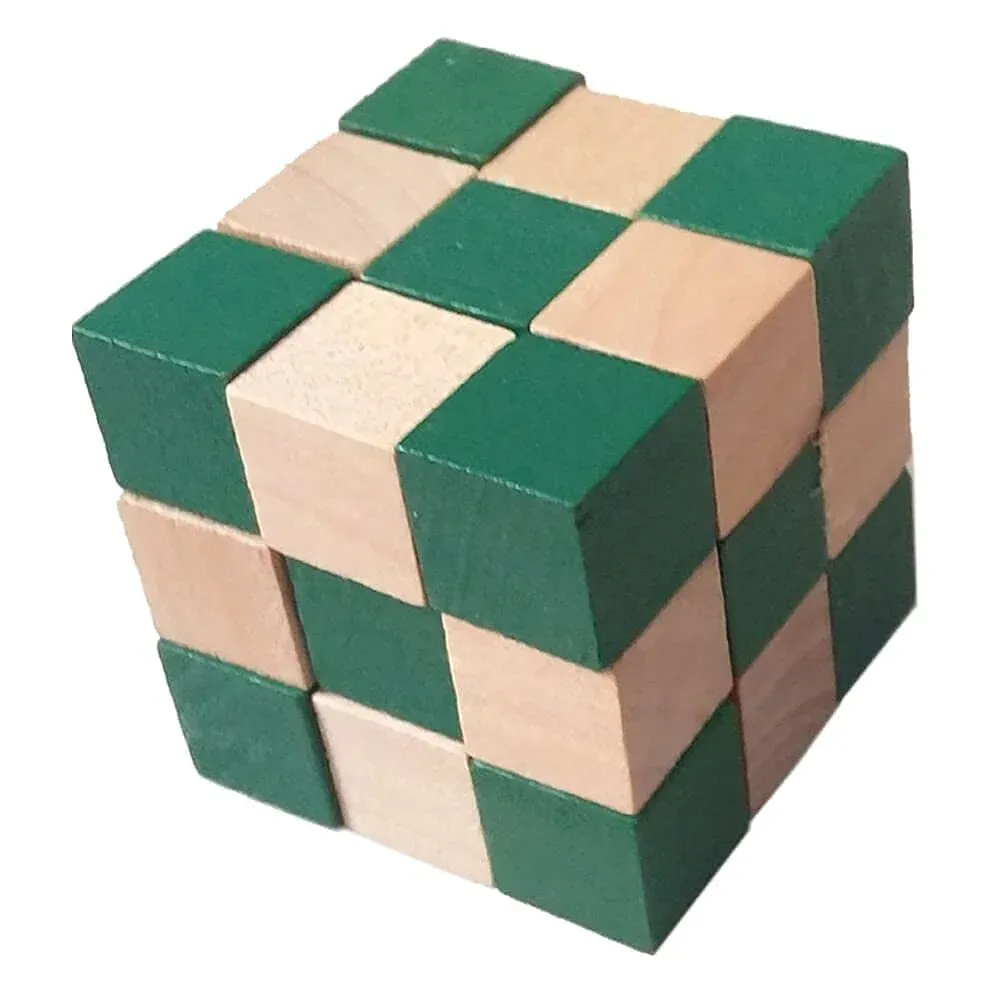
The Cube Snake game's goal is not to align colored squares (as you do with a Rubik's Cube) but to transform this seemingly jumbled chain into a solid, 3D cubic shape without any gaps or overlaps. Here are the types of Snake Rubik's Cube:
- Classic 3x3x3 Snake Cube: The most common version, consisting of 27 small cubes.
- Extended Snake Cubes: Larger variants (e.g., 4x4x4) with more complex folding patterns.
- Magnetic Snake Cubes: Modern versions with magnetic connections for smoother manipulation.
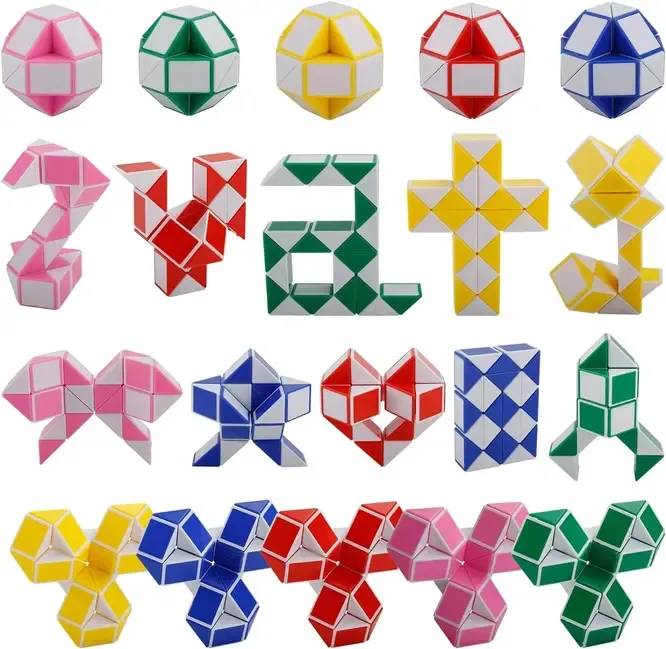
The beauty of the Cube Snake is its simplicity. Unlike puzzles with fixed positions, such as the Rubik's Cube, the Snake Cube's pieces move freely, offering nearly endless possibilities. Solving it requires focusing on spatial arrangement and creative positioning.
The real challenge is that there are no fixed markers or reference points. You might twist and turn it into a shape that looks almost right, only to realize the pieces aren't aligned properly. This forces solvers to think in 3D, creating a truly unique puzzle experience.
How to Solve Snake Cube
While the Rubik's Cube Snake may not involve algorithms like the Rubik's Cube, solving it still requires a methodical approach. Here's a step-by-step guide to solving the Snake Puzzle Cube:
Bonus: While the Snake Cube offers a unique challenge with its flexible segments and need for spatial reasoning, solving it requires hands-on manipulation, and no app can instantly solve it. However, if you're looking to solve traditional 3x3 Rubik's Cubes, the AI Cube Solver App is a great tool.

CubeSolver AI


1. Understand the Puzzle's Structure
The first step to the Snake Cube puzzle solution is to understand how it's structured. It consists of 27 pieces that are connected by flexible joints, and each piece can rotate in multiple directions. The goal is to arrange these pieces into a cube, but the movement is more fluid than fixed.
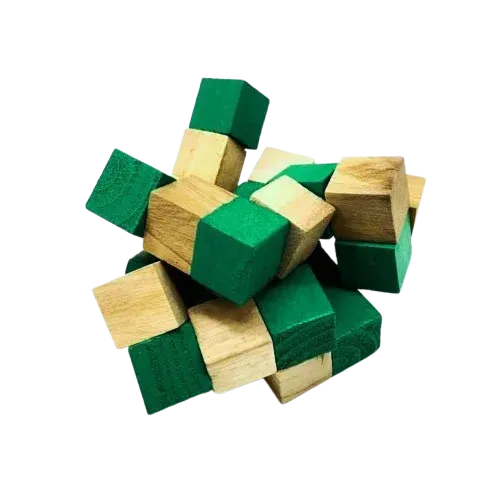
2. Start with the Basic Shape
Start by trying to form the basic cubic shape. It can be helpful to focus on one section at a time, aligning a few pieces into straight lines or curves, which will form the base of the cube. You may want to separate the puzzle into smaller sections, such as the top and bottom halves, before joining them together.
3. Focus on Building One Side at a Time
It's helpful to concentrate on creating one side of the cube first, rather than trying to make the entire cube all at once. Slowly build each side, ensuring the pieces fit and align properly as you go. You'll often need to adjust your approach multiple times, as certain configurations may look close to a solution but still not align perfectly.
4. Keep Experimenting and Be Patient
One of the challenges with the magic Snake Cube is that it's very easy to get stuck, as there are many possible shapes the puzzle can take before you reach the correct configuration. Don't be discouraged—experiment with different rotations, angles, and connections. This trial-and-error process is a key part of the Snake Cube solution, and persistence will eventually lead to success.
5. Finalizing the Cube
Once you've worked your way through building the Snake Cube shapes and aligning all the pieces, the final step is to check the positions and ensure that all the pieces fit snugly into place. The final cube should have equal sides, all aligned at the correct angles, and fully connected.
Mathematical Insights Behind the Snake Cube
The Cube Snake puzzle isn't just a fun brain teaser—it's also a fascinating example of how math appears in everyday puzzles. At its core, the puzzle is a practical exercise in spatial geometry and combinatorics. Each cube is made up of a chain of connected segments, and the way these segments are arranged directly affects whether the puzzle can be folded into a perfect cube.
Not all configurations are solvable. Some sequences lead to dead ends, where the cube can't be completed no matter how you twist it. Mathematicians and puzzle researchers have studied this using tools from graph theory, modeling the puzzle as a network of possible moves and paths. By analyzing these Rubik's Cube Snake patterns, they can determine which arrangements work and which ones are mathematically impossible.
This blend of physical manipulation and abstract thinking makes the fidget Snake Cube more than just a toy—it's a hands-on way to explore math concepts in a fun and challenging form.
Wrapping Up
The Snake Cube might look simple, but it offers a different kind of challenge compared to puzzles like the Rubik's Cube or Petaminx. It's a great way to sharpen spatial thinking, hand coordination, and problem-solving skills. Whether you're just starting or taking a break from more complex puzzles, this cube provides a fun and rewarding experience that's easy to pick up but hard to put down.
Snake Cube FAQ
Q: How do you solve a Snake Cube?
To solve a Snake Cube, you need to fold the connected segments into a 3x3x3 cube without forcing any pieces. Start from one end and follow the chain, carefully turning each segment in a way that builds the cube layer by layer. It's important to plan ahead and visualize the shape as you go
Q: What is the longest Snake Cube?
The longest Snake Cube typically has 64 blocks, forming a 4x4x4 cube when solved. Unlike the standard 27-block version, this larger version is much more complex and requires greater spatial reasoning to solve due to the increased number of segments and possible folding paths.

Kelsey Geller focuses on practical Rubik's Cube learning for beginners. Her guides simplify complex steps, explain the "why" behind moves, and help new cubers build confidence with a reliable solving approach. Every guide follows CubeSolver's editorial review standards before publishing.