The Gear Cube looks familiar at first, but its turning style feels very different from a regular Rubik’s Cube. Its gears move together with each turn, creating a puzzle that is more about mechanical rhythm than speed. This guide explains what a Gear Cube is, how it works, and what to know before trying to solve one.
What Is a Gear Cube?
Gear Cube is not just another Rubik's Cube variation—it's a gear Rubik's Cube that spins with a mechanical rhythm and brings a fresh challenge to the table.
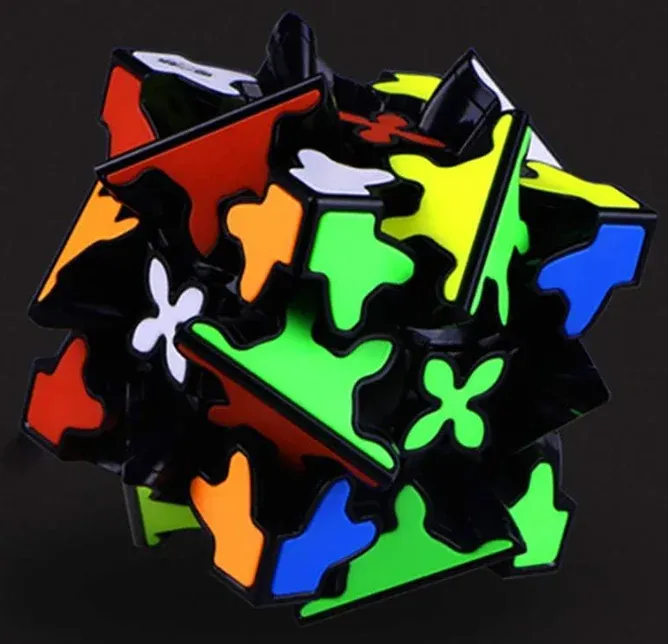
At first glance, the Gear Cube looks like a Rubik's Cube that went steampunk. Its edges are made up of visible interlocking gears, and every move sets off a cascade of spinning pieces. Unlike the standard 3x3 cube where you turn one face and only that layer moves, the Rubik's Gear Cube is interconnected—turn one side, and the gears force other layers to rotate as well.
But here's the kicker: you can't turn it 90 degrees like a normal cube. The gears only allow 180-degree turns, which gives the whole cube a different rhythm and feel. There's something oddly satisfying about watching those gears spin with each move—almost hypnotic.
A Bit of Gear Cube's History
The Gear Cube was invented by Oskar van Deventer, a Dutch puzzle designer known for pushing the boundaries of what a twisty puzzle can be. He teamed up with Meffert's, a well-known puzzle brand, to bring it to life around 2009.
At the time, the puzzle world had seen plenty of odd cubes, but nothing quite like this. The Rubik's Gear Cube immediately caught attention because of its unique mechanics, chunky gear teeth, and the fact that it was both easier and more entertaining to solve than it looked.
How Gear Cube Works
Mechanically, the gear Rubik's Cube is a brilliant piece of engineering. It uses actual meshing gears along its edges. When you twist one face, the adjacent edges turn in sync, meaning the cube is heavily constrained in how it moves. This leads to two interesting effects:
- You can't turn it freely like a normal cube.
- Each move affects more pieces, which creates more visible motion but surprisingly limits the number of possible states.
In fact, because of these constraints, the cube has far fewer combinations than a Rubik's Cube (check Rubik's Cube combinations), making it less about complex solving algorithms and more about understanding its physical behavior.
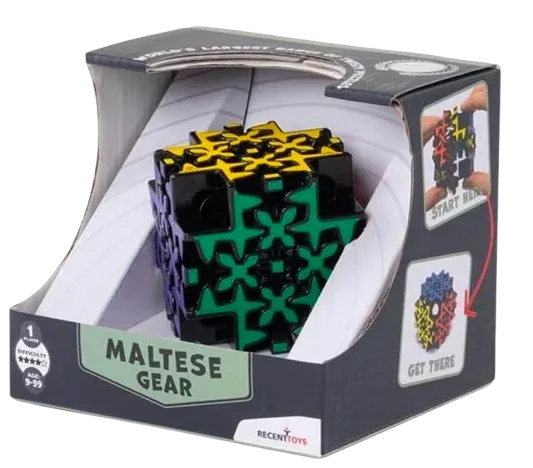
If you're looking to expand your puzzle collection, you might also check out the Maltese Gear Cube—a stunning variant that uses similar gear mechanics but has a unique shape and structure.
How to Solve a Gear Cube
If you've solved a Rubik's Cube in 20 steps before, don't expect the same kind of challenge here. The Gear Cube looks crazy when scrambled, but most people can figure it out with a bit of experimentation. To solve it, the process generally involves 4 to 5 main steps, depending on the specific cube variant you have.
Here's a simple breakdown of how to solve a Gear Cube:
Step 1. Solve the corners.
Start by focusing on the corners. Unlike the standard Rubik's Cube where you start with a white cross, the Gear Cube solution begins by solving the corners first because of how the gears constrain movement. Corner solving is mostly intuitive and involves just a few 180-degree turns, such as R2, D2, or F2. Your goal is to align each corner with the adjacent center colors.
In most cases, this can be done in three to four moves. If you notice two opposite corners already matching, try applying a simple sequence like R2 D2 F2 to bring the remaining ones into place.
Step 2. Align the centers.
Once the corners are set, turn your attention to the centers on each face. Thanks to the way gear movements affect the cube, at least two centers are usually already in the correct position after step one.
Solving the rest is straightforward: use full face turns like D4, R4, or F4 until each center color aligns with its corresponding corners and edges. The process is mostly visual, and you'll often notice the solution clicking into place as the cube becomes more orderly.
Step 3. Permute the edges.
With corners and centers solved, the edge gears now need to be placed correctly. These pieces need to match the colors of the adjacent centers, and this is where a simple algorithm comes in handy.
Repeating the sequence (R2 U) twice is typically enough to cycle the top-layer edge pieces. Depending on your cube's state, you might need to repeat this several times until all the edges fall into place. It's a satisfying moment when the last gear slides into position.
Step 4. Solve inner edges (if applicable).
Some versions of the Gear Cube include inner edge pieces or additional gear segments that also need to be aligned. If your cube has these, they might still look twisted even if everything else is solved. A helpful trick here is to use the move (R2 U2) a few times—usually three repetitions are enough. If your cube doesn't include inner edges, you can safely skip this step.
Step 5. Solve the gears.
Even after all the pieces are in their correct positions, the cube may still look slightly distorted if some gears are twisted. To fix this, rotate each face slowly and deliberately until the gears snap into alignment and the cube returns to its clean, cubic form. Work your way around the puzzle, adjusting one face at a time, until every gear is perfectly aligned and the cube is fully solved.
Tip:
If you're more of a visual learner, watching a step-by-step video tutorial can help make the process easier to follow. Seeing the movements in action makes it clearer how each part of the puzzle interacts.
CubeSolver AI is built for standard color based cubes like 2x2, 3x3, and 4x4. It can help you practice regular cube solving with clear step-by-step visual guidance before you move on to more unusual puzzles like the Gear Cube. For browser practice, you can also use the online cube solver to review standard 3x3 color based solving steps.
Why You'll Love Gear Cube
The Gear Cube isn't just another twisty puzzle—it's a fresh, eye-catching take on the traditional Rubik's Cube. With its unique mechanical look and satisfying movement, it offers a totally different solving experience. Whether you're a seasoned cuber or just curious about puzzle toys, this one has something special to offer.
- It's visually stunning. The gear movement is satisfying to watch.
- It's tactile. The clicks and resistance as you turn make it feel mechanical and real.
- It's approachable. You don't need to learn dozens of algorithms to solve it.
- It stands out. It's one of those puzzles that even non-cubers want to pick up and play with.
And if you're ready to level up, try your hand at the Maltese Gear Cube, which builds on the original's concept but with a more challenging geometry.
Check Out Gear Cube Variants
Once you fall in love with the Gear Cube, there's a whole family of gear-based puzzles to explore. Some fan favorites include:
- Gear Cube Extreme – Similar base, but with a twist—some gears are removed to increase difficulty.
- Gear Ball – A spherical version of the cube with the same satisfying mechanics.
- Gear Shift – Can actually pull apart in the middle and rotate independently—much trickier!
- Geared Mixups – Advanced versions that introduce center rotation and wild shapes.
Final Thoughts
The Gear Cube rewards patience more than speed. At first, the linked turns may feel strange, but each solve helps you notice how the gears move together and how the pieces return to place. Take your time, watch the movement, and let the puzzle teach you its rhythm. Once it clicks, the Gear Cube becomes one of those cubes you keep coming back to.
Gear Cube FAQ
Q: Is the Gear Cube harder than the Rubik's Cube?
Not always. The Gear Cube looks more complex, but its turning rules are more limited than a standard 3x3. The challenge is not memorizing long algorithms. It is learning how the gears move together and waiting for the pieces to line up after each turn.
Q: Can beginners solve the Gear Cube?
Yes. Beginners can solve the Gear Cube, especially if they take time to watch how each turn affects the nearby pieces. It may feel strange at first, but the puzzle is often easier to understand once you stop rushing and let the gear movement guide your next move.
Q: Why does the Gear Cube turn differently?
The Gear Cube turns differently because the visible gears are linked to the movement of the cube. When you turn one layer, nearby gear pieces also rotate. This creates the smooth mechanical motion that makes the puzzle feel different from a regular 3x3.
Q: Can I use a cube solver app for a Gear Cube?
Most cube solver apps are made for standard color based cubes, so they are not the right tool for scanning a Gear Cube. CubeSolver AI supports regular 2x2, 3x3, and 4x4 cubes. If you are still learning basic cube logic, it can help you practice before trying unusual puzzles like the Gear Cube.