The Rubik's Cube, a colorful 3x3 puzzle that's captivated minds for over 40 years, is an enduring challenge for puzzle lovers and casual solvers alike. It's fascinating how a seemingly simple design — six squares of different colors on each of its six faces — can result in so many possible configurations. Whether you're a beginner or an expert cuber, you've probably wondered: how many Rubik's Cube combinations are there?
This question might seem straightforward at first glance, but the answer is both mathematically complex and mind-boggling. To get a clearer picture, let's break down the Rubik's Cube's mechanics and understand how the different combinations are calculated.
The Basics of the Rubik's Cube
Before we dive into the numbers, it's important to understand the Rubik's Cube itself. The standard 3x3 Rubik's Cube is made up of 26 smaller pieces: 8 corner pieces, 12 edge pieces, and 6 center pieces. The center pieces are fixed in position, serving as a reference for the cube's movements, while the edge and corner pieces can be rotated.
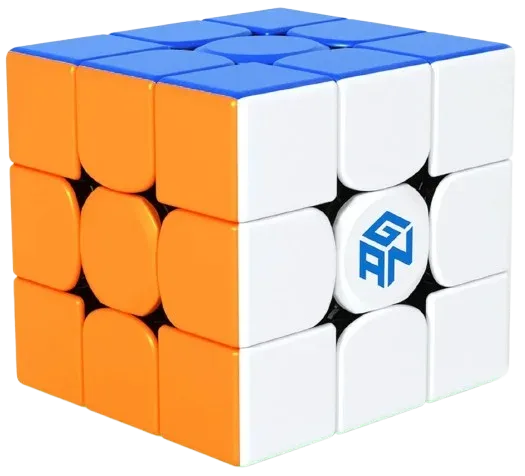
Each piece can be twisted in such a way that the cube can be rearranged into countless different combinations. When you're trying to figure out how many combinations on a 3x3 Rubik's Cube exist, it's important to realize that not every possible arrangement is achievable due to the puzzle's mechanical constraints.
The Mechanics Behind a Rubik's Cube
To solve the 3x3 Rubik's Cube, you must manipulate these pieces through a series of rotations. Each face of the cube can be turned 90, 180, or 270 degrees, resulting in different configurations of the pieces. Importantly, although it may seem like there are just a few movements, the permutations rapidly increase as you consider all possible rotations.
How Many Rubik's Cube Combinations on 3x3?
To figure out how many Rubik's Cube combinations are possible, we need to consider the different ways the cube's pieces can be arranged and oriented. There are several factors that contribute to this, and they are all important to understanding the total number of Rubik's Cube possible combinations.
Factor 1. Corner Permutations
First, let's look at the corner pieces. Each of the 8 corner pieces has three possible orientations, since each corner is made up of three different colored squares. So, there are:
- 3^8 (6,561) possible orientations for the corner pieces.
However, not all of these orientations are valid due to mechanical constraints. The orientation of one corner depends on the others, meaning that the orientations of the corners are not completely independent. Therefore, the number of valid corner orientations is reduced to:
- 3^7 (2,187) possible orientations.
Factor 2. Edge Permutations
Next, we focus on the 12 edge pieces. These pieces can each be flipped in two ways, meaning each edge can be in one of two possible orientations. That gives us:
- 2^12 (4,096) possible orientations for the edges.
Just like with the corners, however, there are restrictions. The orientations of the edges are dependent on each other. In fact, only half of the possible edge orientations are physically achievable. This brings the total to:
- 2^11 (2,048) possible edge orientations.
Factor 3. Corner and Edge Piece Permutation
Now, let's calculate how many ways the corner and edge pieces can be arranged. Since the Rubik's Cube has 8 corner pieces, these can be arranged in:
- 8! (8x8x7x6x5x4x3x2x1=40,320) different permutations.
Similarly, the 12 edge pieces can be arranged in:
- 12! (12x11x10x9x8x7x6x5x4x3x2x1=479,001,600) different permutations.
Factor 4. The Parity Constraint
There's one more important factor to consider: the parity constraint. This means that certain combinations of pieces simply cannot occur. The Rubik's Cube puzzle is designed so that the permutation of all the pieces must be even. This reduces the total number of possible configurations by a factor of 2, ensuring that certain impossible combinations cannot happen.
The Total Number of Rubik's Cube Combinations
Now that we've looked at the various pieces and permutations, we can put it all together to calculate the total number of possible configurations of the Rubik's Cube. The total number of possible combinations is the product of the possible corner permutations, the edge permutations, and the orientations of the pieces.
Here's the equation:
- Total combinations = (8! × 12! × 3^7 × 2^11) / 2
- Total combinations ≈ 43,252,003,274,489,856,000
In simple terms, the total number of Rubik's Cube combinations is approximately 43 quintillion! This means that for every person in the world, there are roughly 6.5 million combinations of the Rubik's Cube to explore.
Solving the Rubik's Cube
Despite this vast number of combinations, one of the remarkable features of the Rubik's Cube is that it is always solvable. No matter how scrambled the cube is, there is always a sequence of moves that will return it to its solved state.
In fact, a well-known theorem in the puzzle world is "God's Number", which states that any configuration of the Rubik's Cube can be solved in 20 moves or fewer. This discovery, made in 2010, shows that even though there are 43 quintillion combinations, a solution is always within reach.
For those who find themselves stuck or just want to speed up the solving process, there's a helpful tool available: the AI Cube Solver app. This app can quickly calculate the optimal solution for any configuration of your Rubik's Cube, taking the guesswork out of the puzzle-solving process.
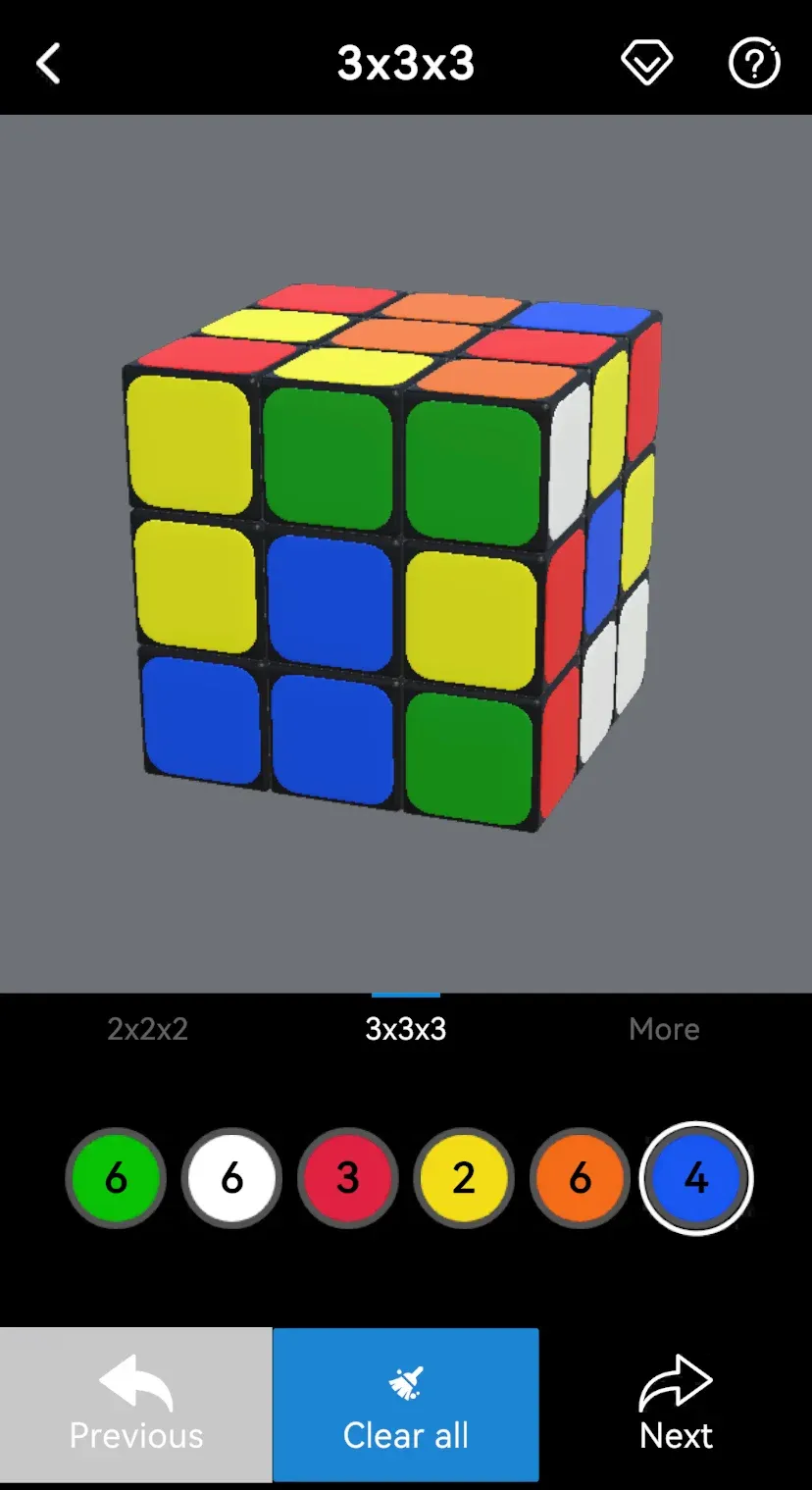
Whether you're a beginner or a seasoned pro, this app can guide you through the necessary moves to solve the cube efficiently. The app is available on both Android and iOS, so you can have it right at your fingertips whenever you need it.
Step 1. Download and install the app on your smartphone.
Step 2. Choose what type of Rubik's Cube you need to solve, like 2x2, 3x3, or 4x4, then upload the cube's state.
Step 3. Wait for the app to calculate the optimal solution. Once it finishes, twist your cube by following the dynamic instructions.
Conclusion
The question how many Rubik's Cube combinations are there has a fascinating answer: approximately 43 quintillion! This staggering number is a testament to the complexity of the Rubik's Cube, and it's one of the reasons why this puzzle has remained popular for over four decades. Whether you're trying to solve the cube using your own methods or following a specific algorithm, knowing the number of Rubik's Cube possible combinations puts into perspective just how intricate this puzzle truly is.
Rubik's Cube Combinations FAQ
Q: What does 43252003274489856000 mean?
The number 43,252,003,274,489,856,000 represents the total number of possible combinations on a standard 3x3 Rubik's Cube. This is approximately 43 quintillion, accounting for all the possible arrangements of the cube's 26 smaller pieces. It highlights the immense complexity of the puzzle.
Q: Is there any configuration of the Rubik's Cube that is impossible to solve?
No, every configuration of a Rubik's Cube is solvable. The puzzle always has a solution, no matter how scrambled the cube may be.
Q: Why can't all the possible orientations of the corner and edge pieces occur?
The orientations of the corner and edge pieces are constrained by the mechanics of the Rubik's Cube. The cube's design only allows for certain configurations, reducing the total number of Rubik's Cube combinations.
Q: How can I solve my Rubik's Cube quickly?
If you're looking for an efficient way to solve your Rubik's Cube, the AI Cube Solver app is a great tool to help you find the optimal solution. It's quick, easy to use, and available for both Android and iOS devices. Download it now and speed up your solving process!
Q: How many possible combinations of a 21x21 Rubik's Cube?
A 21×21 Rubik's Cube has an extremely large number of possible combinations, far greater than the 43 quintillion (4.3 × 10¹⁹) combinations of a standard 3×3 cube.
- 3×3 Rubik's Cube: about 43 quintillion combinations
- 21×21 Rubik's Cube: an astronomically larger number of possible states, effectively impossible to write out in full.