At first glance, a black and white Rubik's Cube looks simpler than a normal cube. The puzzle works the same as a normal 3×3 cube, but the low contrast makes pieces harder to recognize in reality. This guide will walk you through how the puzzle works and how to solve it step by step.
What Is a Rubik's Cube Black and White
A black and white cube is usually just a classic 3×3 Rubik's Cube with monochrome stickers instead of six bright colors. Some versions use black plastic with white stickers, while others use white plastic with black stickers. There are also grayscale sticker sets that use different shades instead of colors.
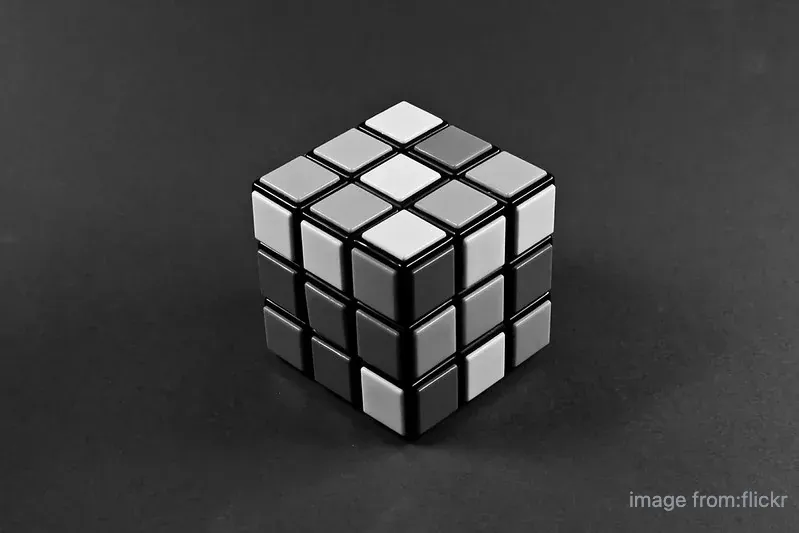
Mechanically, the cube works exactly the same as a normal 3×3. Edges, corners, and centers all function the same way. What makes this version harder is recognition. Without bright colors, it's easier to misread pieces or lose track of them during a solve.
Because of this, many solvers set up a simple recognition system before they start. The easiest method is to mentally label the centers as top, bottom, left, right, front, and back. This gives you clear reference points while solving.
How to Solve a Black and White Rubiks Cube
This section uses a simple beginner layer-by-layer method, adjusted for a low-contrast cube so it is easier to stay oriented as you solve. The solving process is still the same. You just need to check each piece more carefully. Before Step 1, take a minute to set things up:
Choose a fixed orientation. For example, keep the brightest face on top and the darkest face in front.
Make sure you can quickly tell all six centers apart.
Pick one notation style and use it the whole way through.
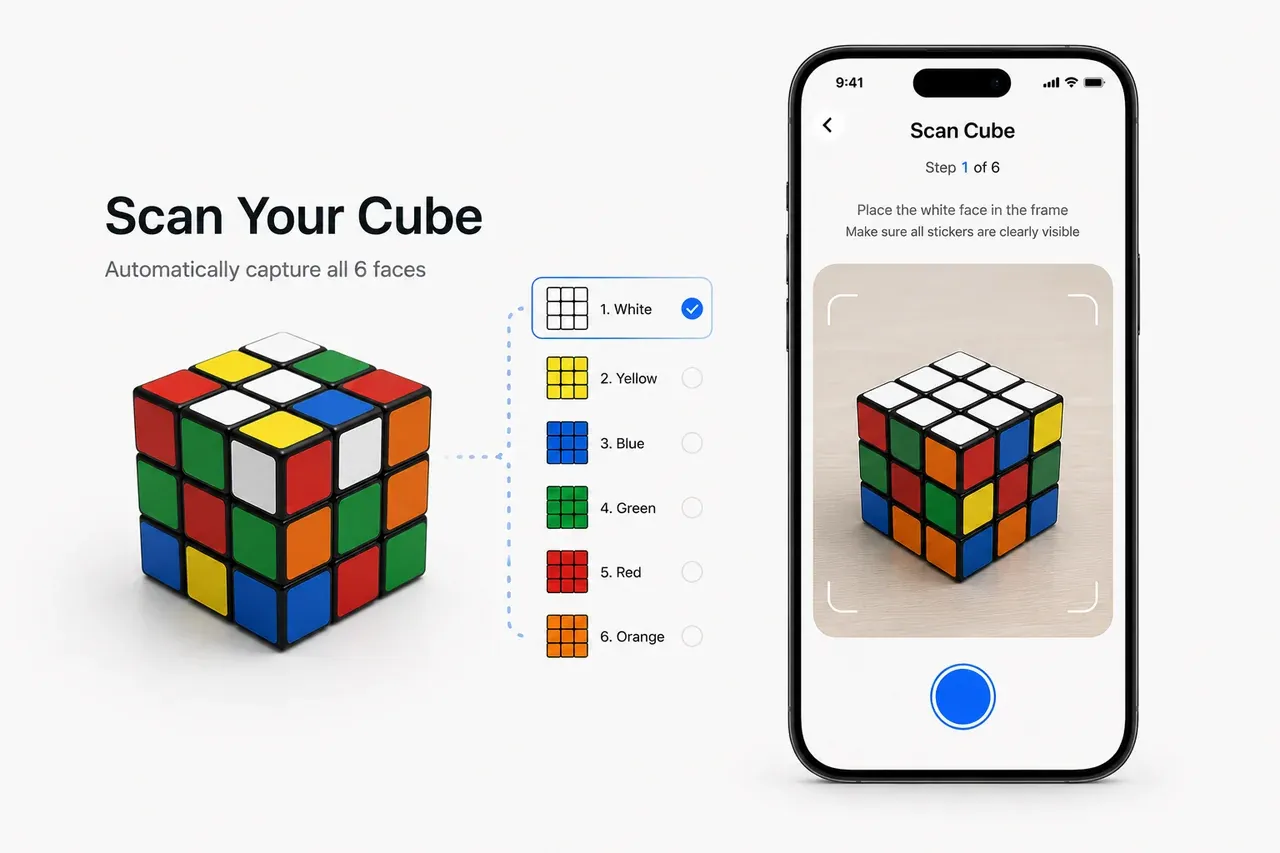
If you get stuck or lose track during a step, an online Cube Solver can help verify the correct moves for a standard 3×3. You can use it as a reference to verify your steps and continue the solution.
Step 1. Build the First Cross
Start by making a cross on your chosen top face. Each edge piece should also match the center color on the cube face below it. When done correctly, you will see a clean cross on top and four matching edge–center pairs around the middle layer.
Common mistake: Many beginners only check the cross from the top. It may look correct, but the side colors might not match their centers. On a monochrome cube, this mistake is easy to miss and can cause problems later when solving the last layer.
Step 2. Insert First-Layer Corners
Place each corner into its correct slot by matching all three faces, not just one sticker shade. When done, the top face should be complete, and each side should show a solid two-piece bar under the top layer.
Common mistake: On a monochrome cube, similar gray tones can be misleading. It's easy to place a corner in the mirrored slot. Before inserting, double-check how the corner matches the side centers.
Step 3. Solve Middle-Layer Edges
Find the edge pieces in the top layer that do not belong to the top face. Insert them into the correct left or right middle slot using the standard beginner triggers. When this step is finished, each side should show a solid vertical bar from top to bottom.
Common mistake: Many solvers rotate the whole cube between inserts and lose their reference. Try to keep the same front face for as long as possible.
Step 4. Form the Last-Layer Cross
Use your usual last-layer edge algorithm to turn the top face from a dot, line, or L-shape into a full cross. At this stage, you only need to orient the edges, not the corners.
Common mistake: On a monochrome cube, similar shades can make the pattern hard to read. Do not rely on tone alone. Check the piece positions first so you know whether you are starting from a dot, line, or L-shape.
Step 5. Align Last-Layer Edges with Centers
Turn the top layer until at least two edges match their side centers. Then use your edge-cycle algorithm until all four edges are aligned. When this step is done, every top edge should match the center on its side.
Common mistake: Do not start solving the corners before all four edges are lined up. This is a very common mistake and often makes the cube seem unsolvable.
Step 6. Position Last-Layer Corners
Move each top-layer corner into its correct position, even if it is twisted the wrong way. Each corner should match the three centers around its slot.
Common mistake: Do not confuse the corner's position with its orientation. In this step, you only need the corners in the correct locations. Twisting them correctly comes next.
Step 7. Twist Last-Layer Corners
Use your usual corner-twisting sequence to orient each corner in place. Turn the top layer to bring the next corner into position as needed. While doing this, the cube may look scrambled for a moment, but it will fix itself after the final corner.
Common mistake: Do not rotate the whole cube between corners. Keep the cube in the same orientation and only turn the top layer to move the next corner into place.
Common Mistakes and Quick Fixes
Fixing small mistakes is often more helpful than learning new algorithms. The issues below are common when solving monochrome cubes, and each quick fix can be used in your next solve.
- Mistake 1: Confusing similar gray shades
You place the right piece type in the wrong slot because the shades look similar.
Quick fix: Use a simple center reference and keep it visible for your first 20 solves. Always match pieces to the center of that face, not just to memory.
- Mistake 2: Losing face orientation mid-sequence
You run the correct algorithm but on the wrong face after rotating the cube.
Quick fix: Choose one "home" front face and return to it before each algorithm. If helpful, say a quick cue like "front fixed" before starting a trigger.
- Mistake 3: Forcing turns when layers feel blocked
A small misalignment makes the cube hard to turn, which can cause pieces to pop or corners to twist internally.
Quick fix: Stop right away and gently realign the layers. Test a few quarter turns. If the cube still feels stiff, check the hardware instead of forcing more moves.
- Mistake 4: Misreading 4×4 parity as a normal error
On black-and-white 4×4 cubes, the last layer may look impossible, leading you to restart the solve.
Quick fix: Learn one OLL parity and one PLL parity algorithm. Apply them after reduction. This is a normal parity case, not a solving mistake.
- Mistake 5: Skipping checkpoints to save time
You rush through early steps and only notice problems near the end of the solution.
Quick fix: Add a quick 3-second check after Steps 1, 3, and 5. These small checks often save more time than restarting the cube.
Wrapping Up
A black and white Rubik's Cube works just like a normal 3×3, but the low contrast makes recognition harder. By keeping a clear orientation, checking pieces carefully, and following the steps in order, you can solve it just like a standard cube. With a little practice, reading the shades becomes easier and your solves will become much faster.
Black and White Rubik's Cube FAQ
What's the rarest Rubik's Cube?
For most buyers, the rarest Rubik's Cube is not one official model but limited production variants, discontinued editions, and event-exclusive releases. In collector circles, rarity usually comes from short manufacturing windows, packaging condition, and provenance.
How to solve a black and white Rubik's Cube 4x4?
Use the standard reduction approach: solve centers, pair edges, then solve as a 3x3. The extra step you must prepare for is Rubik's Cube 4x4 parity, which appears because there are no fixed center orientations like on a 3x3. A practical sequence is:
Build all six centers with strict contrast checks.
Pair all 12 edge pairs.
Solve remaining state using your 3x3 method.
Apply parity algorithms only when needed.
Is there a black and grey Rubik's Cube?
A black and grey Rubik's Cube is usually the same idea as black and white, but with several gray tones across faces. That can look great while increasing recognition difficulty if contrast between adjacent faces is small.
How does the black Rubik's Cube work?
A black Rubik's Cube works through the same internal core, corner, and edge mechanism as any normal 3x3. The visible difference is external: plastic color and sticker palette. Moves, notation, legal states, and solving methods do not change.