Got a Tetris Rubik's Cube and not sure what counts as solved? You are not alone. This puzzle looks like a cube, but the goal is not six solid colors. I recommend learning the 6-Tetrimino finish target first, then using a short, repeatable solve routine. In this beginner guide, you will get clear rules, simple steps, and quick fixes for common mistakes.
What Is a Rubik's Tetris Cube
Before we discuss moves, we need to anchor the product identity clearly. Rubik's Tetris is a collaboration puzzle between Rubik's and Tetris, presented as a shapeshifting, Tetrimino-matching brain teaser cube rather than a classic single-color restore challenge.
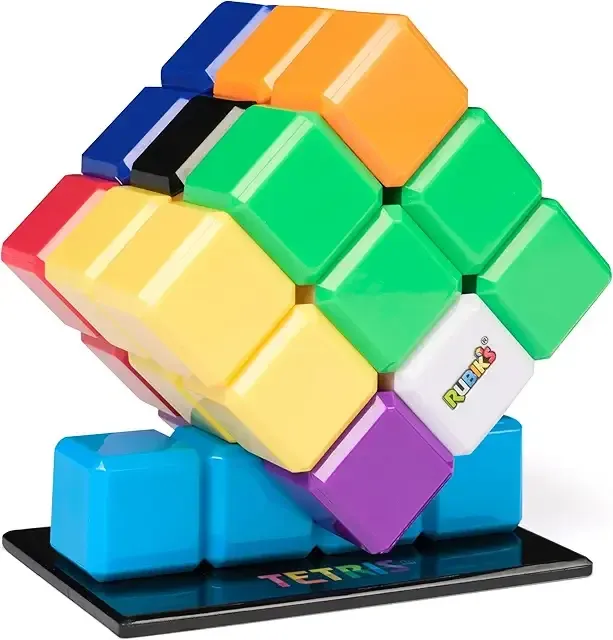
The official product framing focuses on restoring Tetrimino forms across the cube. On the official Rubik's product page, this puzzle is positioned as a higher challenge category, commonly shown as Challenge Level 4.
This official framing changes how you evaluate progress. If your eyes are only checking for single-color sides, you can make clean-looking turns that still move you further from the true finish state.
What Does "Solved" Mean in Rubik's Cube Tetris
Rubik's Cube Tetris pattern is solved only when all 6 faces form the correct Tetrimino shapes. This puzzle is not solved by cube colors, and one clean face does not mean the cube is finished. A solve only counts when every face matches its intended Tetrimino shape. Before finishing, use this quick check:
Check one face and confirm the Tetrimino shape is correct.
Rotate the cube and check the next face.
Repeat until all 6 faces are checked.
If any shape is off by even one block, it is not solved yet.
How to Solve Tetris Rubik's Cube
Once you understand the correct thinking of the Tetris Cube solution, you can start applying a consistent solving strategy. This section explains how to solve Rubik's Tetris Cube using a simple, repeatable approach. Unlike a standard 3×3 Rubik's Cube, Rubik's Tetris does not rely on fixed algorithms. Instead, the goal is to gradually restore the six Tetrimino shapes while keeping previously corrected faces stable.
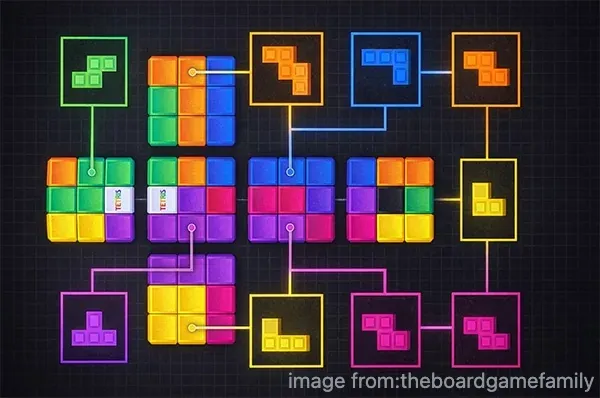
Step 1. Choose a Front and Top Reference
Pick a stable front and top orientation, then mentally map where each Tetrimino outcome belongs. You can rotate the cube and still return to your chosen reference without hesitation.
Common misread: Starting immediately with random turns and no orientation plan creates early drift that is hard to debug later.
Step 2. Build One Correct Tetrimino Face
Build one correct Tetrimino outcome on a chosen face as your control anchor. The target face shape matches the intended block form, not just a similar color patch.
Common misread: Declaring progress because color clusters look cleaner while the actual shape contour is still wrong.
Step 3. Expand to Neighboring Faces
Correct neighboring faces while preserving the first solved shape as much as possible. After every short turn block, at least one solved face remains intact.
Common misread: Solving one side aggressively, then fully breaking previously fixed structure.
Step 4. Make Short Moves and Check Often
Keep moving sequences short, then pause for full-face shape checks. You can explain what each cycle was intended to fix before starting the next cycle.
Common misread: Running long blind sequences because "it worked once" and losing track of what changed.
Step 5. Fix the Smallest Shape Mismatch
Identify the smallest mismatch and fix that first instead of reworking the whole cube. Each correction reduces one concrete mismatch category: orientation, adjacency, or boundary placement.
Common misread: Restarting from scratch too often when only one face relationship is actually wrong.
Step 6. Verify All Six Tetrimino Faces
Validate the entire cube against the official solved condition before ending the attempt. All six faces pass the same Tetrimino-shape standard with no exceptions.
Common misread: Stopping after front/top confirmation and missing a hidden side failure.
Common Tetris Rubik's Cube Solution Mistakes
Even with the right strategy, many solves fail because of a few repeated mistakes. Most beginners do not struggle with turning the cube, they struggle with aiming at the wrong goal or losing track of the cube state. The mistakes below are the ones that most often block progress, along with quick fixes to correct them.
- Mistake 1. Solving solid colors like a normal 3x3
You make the colors look cleaner, but the puzzle still does not meet the Rubik's Tetris solved state. Before each attempt, remind yourself of the real goal: build all 6 Tetrimino shapes, not six solid-color faces.
- Mistake 2. Accepting a false finish after checking only one face
The front face looks correct, but the side or back faces still have broken shapes. Before you finish, always do a full six-face check to make sure every face matches its target Tetrimino shape.
- Mistake 3. Orientation drift during mid-solve adjustments
After a few turns, you are no longer sure which faces are your original front and top, so it becomes hard to tell whether the cube is improving or getting worse. Before each correction cycle, return to your chosen front/top reference and continue from there.
- Mistake 4. Long unplanned move chains
You keep turning, but you cannot clearly say what each sequence is supposed to fix. Keep your move sequences short, then stop and do a shape check before making more turns.
- Mistake 5. Full restarts when only one mismatch remains
You give up on a nearly solved cube and start over, even though only one small shape error is left. Instead of restarting, identify the single remaining problem and fix that first.
Practice Tips and Pattern Progression
Use the staged routine below to train Tetrimino recognition first and speed second. This helps you spot shape problems faster and complete solves more reliably.
Phase 1. Static Shape Recognition
Step 1. Start from a mixed cube and spend 30–60 seconds identifying incorrect Tetrimino boundaries without turning.
Step 2. Name the mismatch type out loud: boundary, adjacency, or orientation.
Step 3. Make your first move only after you can state what specific problem you want to fix.
Phase 2. Slow, Controlled Solving
Step 1. Solve with deliberate turns and pause every 5–8 moves for a full six-face shape check.
Step 2. Keep a short note of where false finishes or shape mistakes occur.
Step 3. Continue until you can complete several clean solves without restarting.
Phase 3. Timed Consistency Practice
Step 1. Run short timed sessions where success means a correct finish, not the fastest time.
Step 2. Track your clean completion rate before focusing on average solve time.

Step 3. If you want to strengthen your cube-solving fundamentals, you can practice with the online CubeSolver AI on for 2×2, 3×3, and 4×4 cubes, then return to manual Rubik's Tetris practice.
Bottom Line
What are Tetris Rubik's Cube instructions? How to solve a Tetris Cube? It is solved when all six faces form the correct Tetrimino shapes, not when the cube shows solid colors. Focus on building one correct face, expanding carefully, and checking all six faces before finishing. Train shape recognition first and speed later to avoid common mistakes and solve more consistently.
Tetris Rubik's Cube FAQ
Is Rubik's Tetris a normal 3x3?
No. It uses cube-style turning mechanics, but the solved objective is different. You are restoring Tetrimino outcomes, not finishing six solid-color faces.
Do I need advanced algorithms to solve Rubik's Tetris?
Not at first. Most learners progress faster with clear objective control, short correction loops, and strict six-face validation.
Is Rubik's Tetris harder than the original 3x3?
For many players, yes, because shape-based verification is less familiar than color-face verification. The puzzle is commonly presented as a higher challenge level product.
Why does Rubik's Tetris Cube look solved on one face but fail overall?
A Rubik's Tetris cube may look solved on one face because that face forms a correct Tetrimino shape, but the cube is evaluated across all six faces. The same pieces belong to multiple faces, so arranging them to fix one face can disrupt the shape on another side.