Solving a Mirror Cube feels strange at first. The puzzle has the same basic structure as a 3x3 Rubik’s Cube, but the pieces are different sizes, and every turn changes its shape. This Mirror Cube Solver guide will help you understand what you are looking at, find the right pieces, and solve the cube step by step using familiar 3x3 methods.
What Is the Mirror Cube
The Mirror Cube, also known as the Bump Cube, is a 3x3 puzzle with a twist. Unlike the standard Rubik's Cube that uses color to differentiate the pieces, the Mirror Cube relies entirely on size. All of its pieces are the same color, but their sizes vary, and the puzzle becomes distorted when scrambled. As a result, solving the Mirror Cube is more about recognizing piece shapes and sizes than colors.
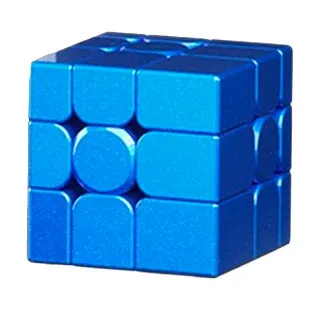
Like the traditional Rubik's Cube, the Mirror Cube has 6 faces, 12 edges, and 8 corners, but the difference lies in the fact that the sizes of the pieces shift. Solving it requires identifying these pieces based on their relative sizes, positioning them correctly, and returning the cube to its original cubical form. The Mirror Cube offers a fresh and intriguing challenge for those looking to expand their puzzle-solving abilities.
Why Is the Mirror Cube Challenging
The Mirror Cube may look similar to a regular Rubik's Cube, but it's far from easy to solve. Here are a few reasons why it can be deceptively difficult:
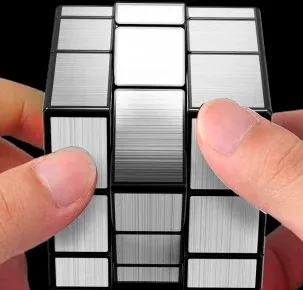
- Shape Recognition: Mirror Cube doesn't use color to guide you. Instead, you must rely on the size of the pieces to figure out where they belong. This requires good spatial awareness and the ability to visualize how pieces fit together.
- No Visual Cues: In a standard Rubik's Cube, cube colors help you track your progress, but in the Mirror Cube, you're left with only the size of the pieces. Without those color cues, it can be harder to tell whether you're getting closer to solving the puzzle.
- Orientation Confusion: Since the pieces are all the same color, it's easy to lose track of which pieces are in the right spots. The absence of familiar visual references adds another layer of complexity to the puzzle.
How to Solve a Mirror Cube
Solving a Mirror Cube may feel intimidating at first, but it becomes easier when you treat it like a 3x3 shape mod. Instead of matching colors, focus on piece size, shape, and position. Follow the layers one by one, and the puzzle will start to feel much more familiar.
Bonus: If you are still learning the basics, practice with a standard 3x3 cube first. CubeSolver AI is built for color based cubes like 2x2, 3x3, and 4x4, so it can help you learn the regular solving logic before you try the Mirror Cube. The Mirror Cube itself is solved by shape, not color.
Procedure 1: Solve the Centers
The first procedure of the 3x3 Mirror Cube Solver is to arrange the center pieces. These are the fixed pieces in the middle of each face and serve as key reference points for the rest of the puzzle. Each face's center should match the size of the surrounding edge pieces.
Step1. Start by finding the largest center piece, as this will act as your reference point.
Step 2. Begin by aligning the center pieces on each face, making sure they match the corresponding sizes around them.
Step 3. Ensure all center pieces are correctly placed before moving on to the next step. This is crucial because the entire solving process relies on getting the centers right.
Procedure 2: Solve the Edges
How to solve a Mirror Cube? Next, focus on the edge pieces. There are 12 edge pieces in the Mirror Cube, and your goal is to pair them with the correct center pieces based on their size. This procedure is similar to edge pairing in the traditional Rubik's Cube, but instead of color, you'll focus on matching the pieces by size.
Step 1. Identify edge pieces that need to be paired with the corresponding center pieces of the same size.
Step 2. Work with one layer at a time (usually the top or bottom layer) to align the edges.
Step 3. Use familiar edge-pairing algorithms, but remember, you'll need to pair based on size rather than color. This makes it a bit more intuitive, but be mindful of the relative sizes.
Procedure 3: Solve the Corners
After you've solved the centers and edges, the final procedure of the Mirror Rubik's Cube solver is to position the corner pieces. These pieces sit at the intersections of the edges, and their correct placement is crucial for completing the cube. They need to be positioned based on size and shape.
Step 1. Identify the corner pieces and determine where each should go. Each corner needs to match the adjacent edge pieces by size.
Step 2. Once you've found the correct positions for all the corners, rotate them into place.
Step 3. If the corners are in the right spots but not oriented correctly, use algorithms like R U R' U to adjust their orientation without disrupting the rest of the puzzle.
Algorithms to Help Solve the Mirror Cube
Here are a few essential algorithms that can help you conduct the Mirror Cube solution more efficiently:
Edge Pairing Algorithm
To solve the edge pieces, you'll need to pair them correctly with the center pieces. This algorithm switches the positions of edge pieces to ensure they're aligned properly by size: R U' R' U' R U2 R'
Corner Permutation Algorithm
Once your corners are in the right spots but not yet oriented correctly, this algorithm helps permute (or swap) the corners into their correct positions: R U R' U R U2 R'
Corner Orientation Algorithm
After the corners are positioned correctly, you might find that they need to be oriented (flipped) to complete the puzzle. This algorithm is designed to adjust the orientation of the corners without affecting the rest of the cube: R U R' U' R U R' U'
Common Mistakes and Troubleshooting Tips
When it comes to the Rubik's Cube mirror solution, you might encounter a few common problems. Here are some helpful troubleshooting tips to guide you through:
1. Misaligned Centers
If your center pieces are not aligned properly, it can throw off the entire puzzle. This typically happens when you focus on color rather than size.
- Double-check that the centers are aligned by size, not color. The largest center piece should be in the middle of the face, with progressively smaller pieces around it.
- If they're out of place, adjust the centers first, then proceed with solving the edges. The centers must be correctly positioned before moving forward with the puzzle.
2. Edge Misalignment
Sometimes, the edge pieces won't align correctly with the centers, causing parts of the puzzle to remain unsolved.
- Use edge-pairing algorithms to pair the edge pieces with the appropriate center pieces, based on their size.
- Work with one layer at a time to align the edges, being careful not to disturb the centers. Ensure the edges are positioned correctly before proceeding.
3. Corner Misplacement
If the corner pieces are in the wrong spots during the Rubik's Cube Mirror 3x3 solutions, the puzzle won't be solved even though the centers and edges are in place.
- If the corners are misplaced, use a corner permutation algorithm to swap them into their correct positions.
- Once in the right spots, if the corners need to be rotated (or oriented), use a corner orientation algorithm to fix their alignment without affecting the rest of the cube.
Why Should You Try the Mirror Cube
If you're comfortable solving the traditional Rubik's Cube, the Mirror Cube offers a unique challenge that will push your problem-solving abilities and spatial reasoning to the next level. Here's why you should give it a try:
Enhances Problem-Solving Skills
Unlike the standard Rubik's Cube, the Mirror Cube requires you to focus on the size and shape of the pieces rather than their colors. This forces you to think differently and approach the puzzle with a fresh mindset. It's a great way to develop more advanced problem-solving techniques.
Fun and Rewarding Challenge
The Mirror Cube offers a satisfying and rewarding puzzle-solving experience for those who enjoy a new challenge. Its unique approach will keep puzzle enthusiasts engaged, providing a break from the more familiar Rubik's Cube while still offering the same level of mental stimulation. Completing it is especially satisfying when you realize how the size-based mechanics lead to the final solution.
Improves Spatial Awareness
Solving the Mirror Cube strengthens your spatial awareness and visualization skills. You'll need to mentally visualize how the pieces fit together based on size and shape, which helps improve your ability to understand and manipulate objects in space. This can transfer to other areas of problem-solving, making you more adept at visualizing and planning complex tasks.
Conclusion
Solving the Mirror Cube takes patience, but each layer becomes easier as you learn how the pieces fit together. Start slowly, check the height and shape of each piece before making a move, and return to this Mirror Cube Solver guide whenever you lose track. With steady practice, the puzzle becomes less of a guessing game and more of something you can read with confidence.
Mirror Cube Solver FAQ
Q: Why does the Mirror Cube change shape?
The Mirror Cube changes shape because its pieces are cut in different sizes. When you turn a layer, tall and short pieces move out of their solved positions, so the cube no longer looks like a clean block. As you solve it, the shape slowly returns to a cube. This is also why the puzzle feels harder to read than a normal 3x3.
Can I use a cube solver app for a Mirror Cube?
Most cube solver apps are built for standard color based cubes, so they are not the right tool for scanning a Mirror Cube. A Mirror Cube needs shape recognition, not color recognition. You can still use a cube solver app to practice regular 3x3 solving logic, which helps when you move on to the Mirror Cube.
Q: Do I need advanced algorithms to solve a Mirror Cube?
No. Most Mirror Cube solves use the same basic ideas as a beginner 3x3 method. The challenge is not a new set of algorithms. The hard part is finding the correct piece when colors do not help. Once you can identify corners, edges, and centers by shape, the solve becomes much more manageable.
Q: Is the Mirror Cube harder than a regular Rubik’s Cube?
For most beginners, yes. The turning logic is similar to a regular 3x3, but the Mirror Cube removes the color clues that many solvers rely on. You need to judge piece size and position instead. If you already know how to solve a 3x3, the Mirror Cube is a good next challenge rather than a completely new puzzle.