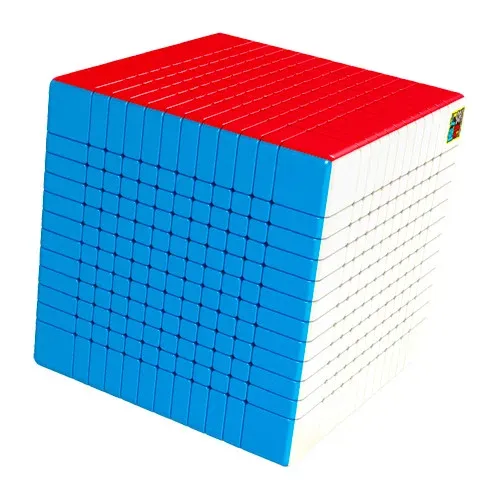
How to Solve a 12x12 Rubik's Cube
Solving a 12x12 cube follows the reduction method, which is commonly used for big cubes like 6x6, 8x8, and 10x10. The basic idea is to first solve the centers, then pair the edges, and finally solve it like a 3x3 cube.
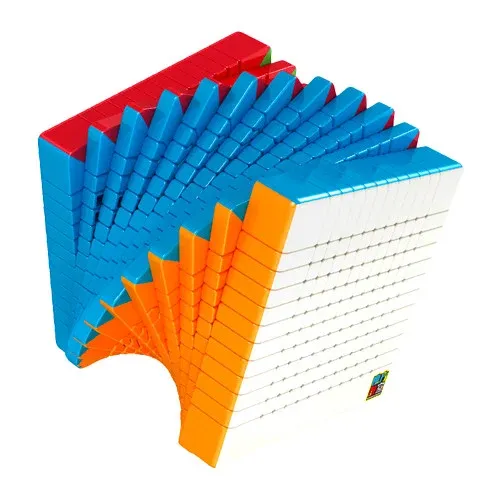
Before we break down each step, let's understand an important concept: parity errors.
Why Is Parity More Common in the 12x12?
Parity refers to a situation where one or more pieces are incorrectly positioned or oriented in a way that isn't possible on a standard 3x3 cube. Even-layered cubes like the 12x12 often result in edge parity errors, which require special algorithms to fix.
Procedure 1: Solve the Centers
The first procedure in tackling a Rubik's Cube 12x12 is to solve all six center faces, which lays the foundation for simplifying the puzzle. Since this cube has an extensive number of pieces, organization is key.
Step 1. Choose a starting color, the most cubers begin with white or yellow to maintain consistency.
Step 2. Form solid center blocks, carefully group the smaller center pieces together, creating a uniform color block in the middle of each face.
Step 3. Use strategic moves, R (Right), U (Up), L (Left), and D (Down) moves to maneuver the pieces into place, ensuring that completed sections remain undisturbed.
Step 4. After completing one, move on to the opposite center, and then gradually work through the rest, maintaining the correct color orientation.
Tip: Solve opposite centers first—White-Yellow, Blue-Green, Red-Orange—to make the process more intuitive and minimize errors as you progress.
Procedure 2: Pairing the Edge Pieces
With the centers solved, the next challenge is to pair the edge pieces so that each edge consists of identical smaller segments. This step is crucial in reducing the 12 by 12 Cube into a more familiar 3x3 form.
Step 1. Turn the cube to find two identical edge pieces that belong together.
Step 2. Apply specific pairing and swapping algorithms to align and connect matching edge pieces without disrupting the solved centers.
Step 3. Continue pairing until every edge is complete. At this stage, the cube should resemble a scrambled 3x3, making it ready for the final solving phase.
Procedure 3: Solve Like a 3x3 Cube
Once all edges are paired, the 12x12 cube essentially functions like a standard 3x3 Rubik's Cube. However, due to its even-layered nature, you might encounter two common parity errors that don't occur in odd-layered cubes.
Step 1. Use OLL Parity (Orientation of the Last Layer. This happens when one or more edge pieces are flipped incorrectly, making it impossible to complete the yellow face using normal 3x3 algorithms.
Step 2. Use PLL Parity (Permutation of the Last Layer). This occurs when two edge pieces need to be swapped, a situation that doesn't arise in a regular 3x3 solve.
Common Challenges with the Rubik 12x12
Solving the Cubo Rubik 12x12 is no small feat, and it presents a unique set of challenges that require patience, skill, and careful attention. Here's a breakdown of the most common issues you might face and how to handle them:
Edge Pairing Mistakes
Pairing edges on a 12x12 cube is a time-consuming task, and one incorrect move can disrupt multiple layers. The challenge here is maintaining pattern recognition while keeping track of completed edges. Unlike a 4x4 or 6x6, there are five edge pieces per side, increasing the chances of misalignment.
To avoid mistakes, use the edge-pairing algorithm methodically, and always double-check each completed edge before moving on. If you spot a mismatch, don't hesitate to undo the last few moves and correct the error. Patience is key!
Parity Errors in the Last Layer
Parity is one of the most frustrating challenges in solving large cubes. Unlike odd-layer cubes, even-layered puzzles introduce cases where flipped edges or swapped pieces break the standard algorithms. Since these errors don't exist on a 3x3, many solvers struggle with fixing them efficiently.
The only way to solve parity errors is to use specialized parity algorithms that target flipped or swapped pieces. Familiarize yourself with these sequences, and practice them regularly to fix these issues smoothly when they arise. The more you practice, the more confident and efficient you'll become at handling these cases.
Physical Difficulty (Lock-Ups & Turning Resistance)
The Rubik's Cube 12x12's sheer size makes it physically difficult to turn. Unlike smaller cubes, this puzzle has many layers, which increases friction and the likelihood of lock-ups. Additionally, large cubes are prone to piece misalignment, which can jam the mechanism.
To minimize turning resistance, use a high-quality cube designed for smooth movement. Before executing each move, make sure the layers are properly aligned to avoid any misalignment issues. If you experience resistance or lock-ups, try loosening the tension slightly (if possible) or applying lubricant to improve turning efficiency.
Expert Tips for Solving a Rubik's 12x12x12
Use Finger Tricks Efficiently
Large cubes like the 12x12 can be cumbersome to handle, so it's important to master gentle yet precise turning techniques. Finger tricks help you move the layers swiftly without adding too much force. Practice using your fingers for turning, especially when handling more complex sequences, to avoid straining your wrists and reduce unnecessary movement.
Avoid Rushing
While it's tempting to solve quickly, speed is secondary to accuracy. The 12x12 cube requires patience, as small mistakes can cascade and set you back significantly. Focus on making deliberate, accurate moves rather than rushing through the process. A careful approach will help you avoid having to backtrack and correct errors, saving you time in the long run.
Lubricate the Cube
Proper lubrication can make a world of difference in the smoothness of your turns. Reducing friction allows the pieces to move more easily and can prevent lock-ups. Invest in a good-quality lubricant specifically designed for cubes and apply it to the core and pieces periodically to maintain smooth turning throughout your solve.
Memorize Parity Algorithms
One of the most time-consuming aspects of solving large cubes is dealing with parity errors. Memorizing the specialized parity algorithms will save you precious time when these errors occur. Since parity errors don't happen in smaller cubes, learning these sequences early will ensure you're prepared for the tricky moments and can fix them efficiently.
Wrapping Up
The 12x12 Rubik's Cube is not just a puzzle—it's a test of endurance, patience, and advanced problem-solving. Unlike the standard 3x3 cube, this massive cube introduces intricate edge pairing, challenging parities, and increased complexity, making it one of the toughest non-WCA puzzles available.
12x12 Rubik's Cube FAQ
Q: Is there a 12x12 Rubik's Cube?
Yes, there is a 12x12 Rubik's Cube. It is one of the larger, more complex versions of the traditional Rubik's Cube, featuring 12 squares on each side, making it a significant challenge to solve. The 12x12 cube offers a greater number of smaller pieces, which increases the difficulty compared to the standard 3x3, requiring advanced techniques and patience to complete.
Q: What's the hardest Rubik's Cube?
The hardest Rubik's Cube is generally considered to be the 17x17 Rubik's Cube. With 17 squares on each face, it has a massive number of smaller pieces, making it incredibly complex to solve. The higher number of pieces introduces more challenges, such as difficult edge pairing, intricate algorithms, and frequent parity errors, which require advanced techniques and a lot of patience to resolve.